Normal Distribution 1
Normal Distribution
Author: Dr. Brajesh Kumar Jha
Introduction
The Normal Distribution (also known as the Gaussian Distribution) is a continuous probability distribution that describes data clustering around a mean value in a symmetric, bell-shaped curve. It is widely used in statistics, science, and engineering to model real-world phenomena such as heights, weights, IQ, and measurement errors.
Definition and Formula
A random variable X is said to follow a Normal Distribution with mean μ and standard deviation σ if:
\f(x)=(1/(σ√(2π)))*e^(-½((x-μ)/σ)²), -∞ < x < ∞
- μ = Mean (center of the curve)
- σ = Standard Deviation (spread)
- Total area under the curve = 1
Normal Distribution Curve
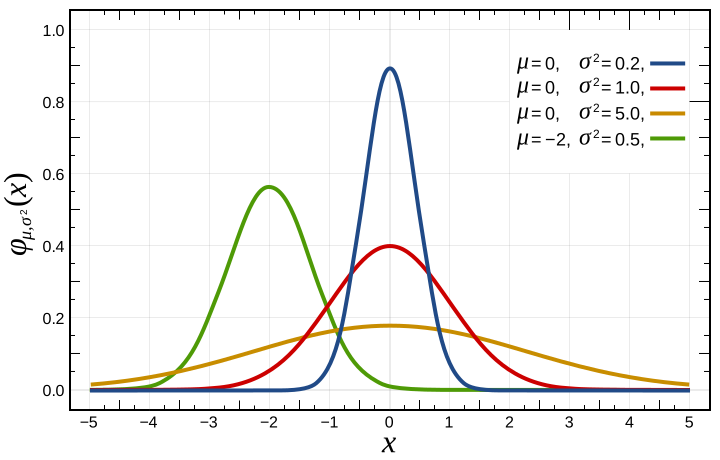
Properties of Normal Distribution
- Bell-shaped and symmetric about the mean.
- Mean = Median = Mode.
- Total area under the curve is 1.
- 68.26% of data lies within μ ± σ.
- 95.44% within μ ± 2σ.
- 99.73% within μ ± 3σ.
- Curve is asymptotic to the X-axis.
Standard Normal Distribution
When μ = 0 and σ = 1, the variable Z is defined as:
Z = (X - μ) / σ
Z is called the Standard Normal Variable. Probabilities are calculated using the Z-table.
Standard Normal Table (Partial)
| Z | 0.00 | 0.01 | 0.02 | 0.03 | 0.04 |
|---|---|---|---|---|---|
| 0.0 | 0.5000 | 0.5040 | 0.5080 | 0.5120 | 0.5160 |
| 0.1 | 0.5398 | 0.5438 | 0.5478 | 0.5517 | 0.5557 |
| 0.2 | 0.5793 | 0.5832 | 0.5871 | 0.5910 | 0.5948 |
| 0.3 | 0.6179 | 0.6217 | 0.6255 | 0.6293 | 0.6331 |
| 1.0 | 0.8413 | 0.8438 | 0.8461 | 0.8485 | 0.8508 |
| 1.5 | 0.9332 | 0.9345 | 0.9357 | 0.9370 | 0.9382 |
| 1.96 | ≈ 0.9750 | ||||
Practical Applications
- Education: Modeling students' test scores or IQ distribution.
- Manufacturing: Analyzing product weights or diameters for quality control.
- Biology: Studying variation in plant or animal sizes.
- Finance: Modeling returns on investment portfolios.
Solved Examples
Example 1:
Find P(40 < X < 60) for X ~ N(50, 10).
Z₁ = (40 - 50)/10 = -1,   Z₂ = (60 - 50)/10 = 1
P(-1 < Z < 1) = 0.6826
Answer: 0.6826
Example 2:
Find P(X < 85) for X ~ N(100, 15).
Z = (85 - 100)/15 = -1
P(Z < -1) = 0.1587
Answer: 0.1587
Example 3:
Find P(X > 115) for X ~ N(100, 15).
Z = (115 - 100)/15 = 1
P(Z > 1) = 1 - 0.8413 = 0.1587
Answer: 0.1587
Example 4:
For X ~ N(70, 8), find P(62 < X < 78).
Z₁ = -1, Z₂ = 1 ⇒ P(-1 < Z < 1) = 0.6826
Answer: 0.6826
Summary
| Range | Area Under Curve (%) |
|---|---|
| μ ± 1σ | 68.26% |
| μ ± 2σ | 95.44% |
| μ ± 3σ | 99.73% |
Application
The Normal Distribution is a cornerstone of probability and statistics. It is essential in data analysis, quality control, hypothesis testing, and predictive modeling across diverse scientific and engineering fields.


Comments
Post a Comment